
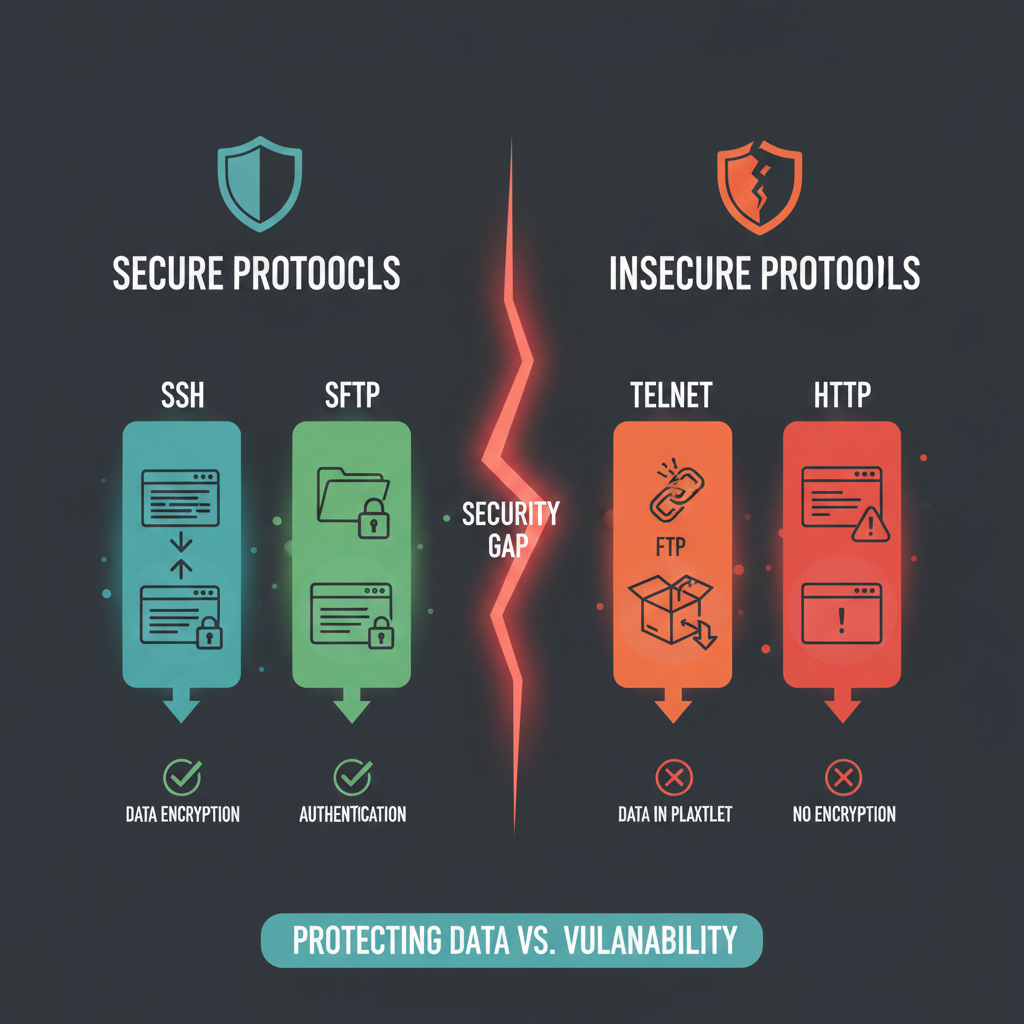
Secure communication protocols eliminate the risk of plain-text data interception by establishing encrypted tunnels across untrusted networks. Administrators use SSH, SFTP, and HTTPS to protect credentials, secure file transfers, and authenticate web traffic against eavesdropping and man-in-the-middle attacks.
Secure Shell (SSH)
Secure Shell (SSH) replaces legacy, unencrypted protocols like Telnet by establishing a secure command-line channel over TCP port 22. During an SSH connection, the client and server negotiate a secure tunnel using a Diffie-Hellman key exchange. They create a shared symmetric key—a single cryptographic key used to rapidly encrypt and decrypt the entire session. Next, the server verifies the client’s identity using public-key cryptography.
To harden SSH, security engineers disable password authentication entirely. Instead, they require cryptographic keys, specifically using the Ed25519 algorithm, which offers superior performance and security compared to older RSA keys. Administrators also configure the sshd_config file to disable root login (PermitRootLogin no), forcing users to log in with standard privileges before they can attempt to escalate their access levels.
SSH File Transfer Protocol (SFTP)
SSH File Transfer Protocol (SFTP) leverages the existing SSH infrastructure to transfer large datasets securely, replacing vulnerable legacy protocols like FTP. Because SFTP operates entirely within the SSH protocol over TCP port 22, it automatically inherits SSH’s encryption and authentication mechanisms.
To harden SFTP environments, administrators implement chroot jails. A chroot jail modifies the apparent root directory for a specific user, confining them to a designated folder and preventing them from navigating the wider server file system. Engineers also configure the SSH daemon to restrict SFTP-only users from executing terminal commands, ensuring those accounts strictly perform file transfers and cannot manipulate the underlying operating system.
Hypertext Transfer Protocol Secure (HTTPS)
Hypertext Transfer Protocol Secure (HTTPS) protects web traffic over TCP port 443 using Transport Layer Security (TLS). When a browser connects to a secure website, the server presents a digital certificate to prove its identity. The client and server execute a TLS handshake to agree on cryptographic algorithms and establish an encrypted session.
Modern enterprise environments strictly enforce TLS version 1.3, configuring firewalls and web servers to drop connections attempting to use older, vulnerable protocols like TLS 1.0, TLS 1.1, or SSL. Security teams further harden web applications by implementing HTTP Strict Transport Security (HSTS). HSTS is a web server directive that forces client browsers to interact with the application only over encrypted HTTPS connections. This strict policy neutralizes protocol downgrade attacks, where a threat actor attempts to force a user’s connection back to unencrypted HTTP.
Mastering these secure protocols forms the foundation of modern network defense. To structure your study plan around network hardening, secure protocols, and other enterprise security domains, review The Ultimate Guide to CompTIA Security+ (SY0-701) in 2026.
Leave a Reply