
Subnetting divides large, congested physical networks into smaller, isolated logical networks to contain broadcast traffic and enforce security boundaries. While IPv4 subnetting requires complex bit-borrowing to conserve a rapidly depleting address pool, IPv6 leverages a massive 128-bit architecture to eliminate scarcity and streamline hierarchical routing.
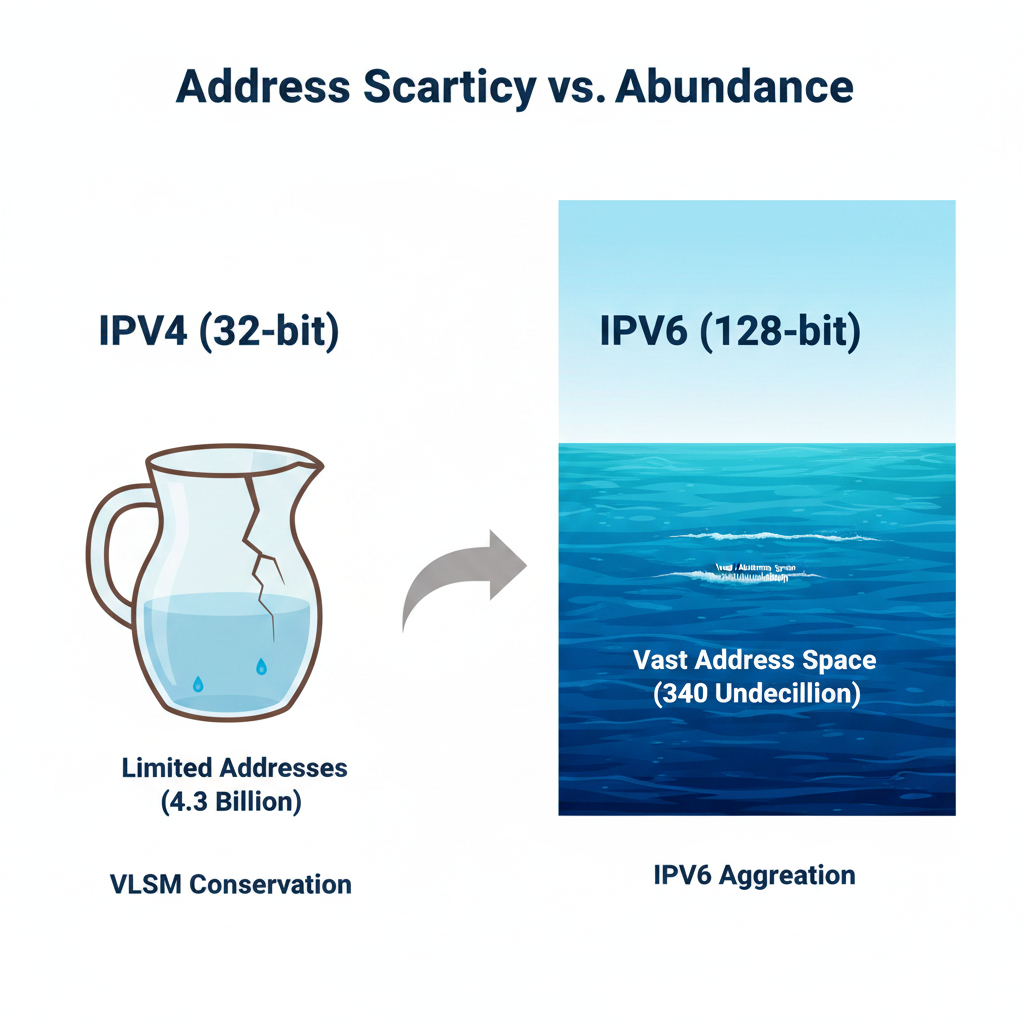
IPv4 Mechanics: Conservation and CIDR
IPv4 utilizes a 32-bit address space, providing approximately 4.3 billion unique addresses. Because this pool is exhausted, network administrators must aggressively conserve IP addresses using Variable Length Subnet Masking (VLSM). VLSM allows engineers to carve a single network block into multiple subnets of varying sizes, allocating exactly the number of addresses required for a specific VLAN or department.
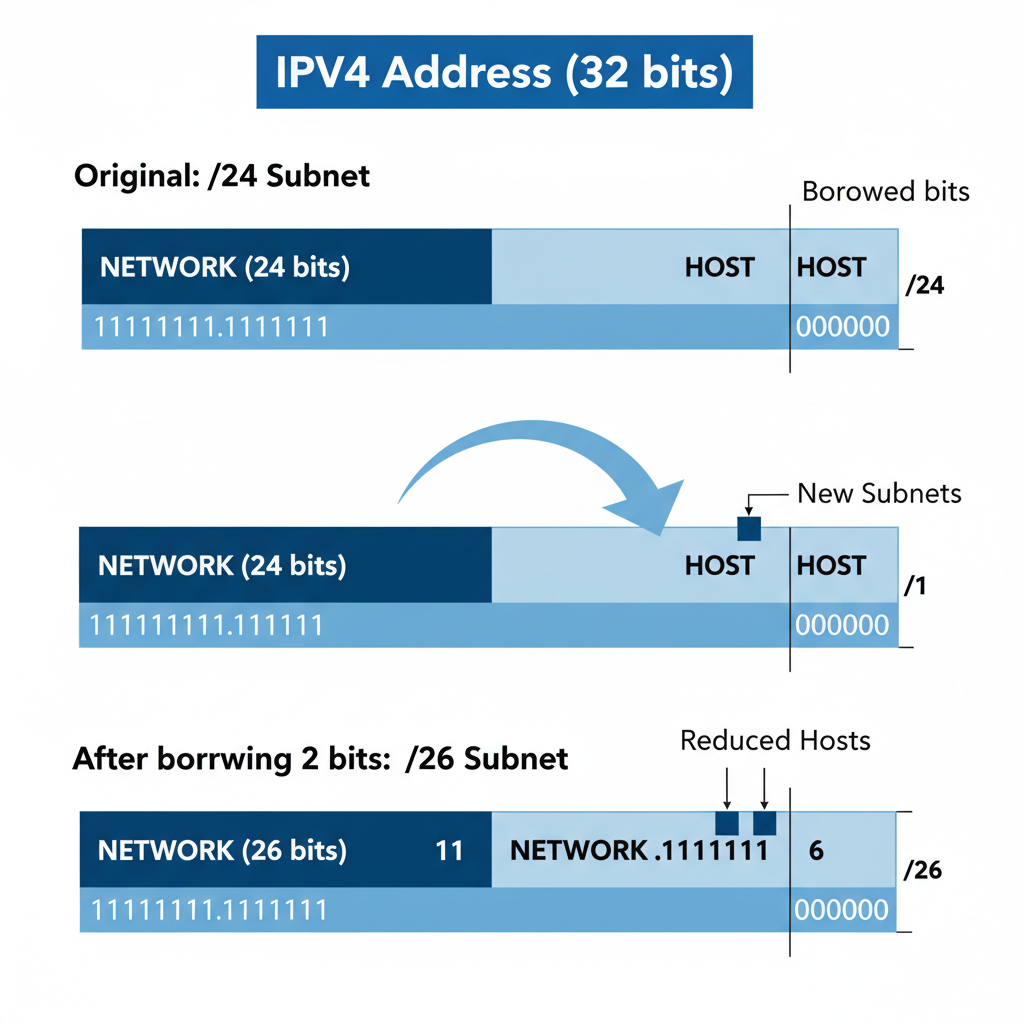
Administrators execute this division using Classless Inter-Domain Routing (CIDR) notation. CIDR ditches rigid legacy class boundaries (Class A, B, C) and instead defines the network portion using a slash followed by the number of active network bits (e.g., /24). To create a subnet, the router borrows bits from the host portion of the address and reassigns them to the network portion.
text
# IPv4 Subnetting Example (Borrowing 2 bits)
Original Network: 192.168.1.0/24 (Provides 1 network with 254 usable hosts)
Goal: Divide into 4 smaller subnets.

Action: Borrow 2 host bits (2^2 = 4 subnets). The CIDR shifts from /24 to /26.
New Subnet Mask: 255.255.255.192

Subnet 1: 192.168.1.0/26   (Usable Hosts: .1 to .62)
Subnet 2: 192.168.1.64/26  (Usable Hosts: .65 to .126)
Subnet 3: 192.168.1.128/26 (Usable Hosts: .129 to .190)
Subnet 4: 192.168.1.192/26 (Usable Hosts: .193 to .254)
IPv6 Mechanics: Abundance and Hexadecimal Structure
IPv6 discards the conservation mindset entirely. It deploys a 128-bit address space formatted in hexadecimal (base-16), generating an almost infinite pool of addresses. Instead of agonizing over VLSM to save host addresses, engineers subnet IPv6 for organizational hierarchy and route aggregation.
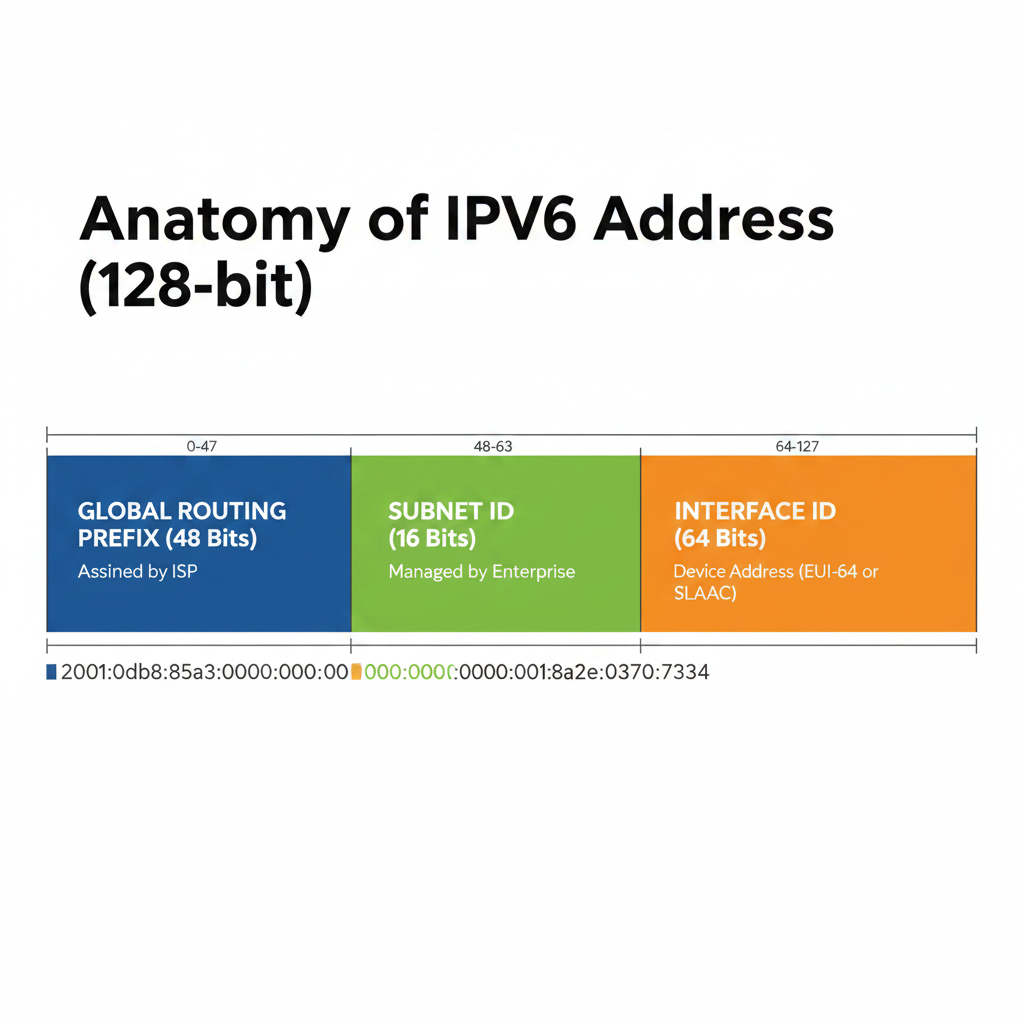
An enterprise typically receives a /48 Global Routing Prefix from an Internet Service Provider (ISP). The IPv6 architecture reserves the next 16 bits strictly for the Subnet ID. This gives a single organization 65,536 standard subnets. The remaining 64 bits formulate the Interface ID—the unique identifier for the host device itself.
text
# IPv6 Subnetting Example
ISP Assignment (Global Routing Prefix): 2001:0db8:acad::/48
Subnet ID Field: 16 bits available (0000 through FFFF)
Standard Host Network Size: /64

Subnet 1: 2001:0db8:acad:0001::/64
Subnet 2: 2001:0db8:acad:0002::/64
Subnet 3: 2001:0db8:acad:0003::/64
Subnet 4: 2001:0db8:acad:0004::/64
In this architecture, every standard LAN segment automatically receives a /64 subnet, providing 18 quintillion host addresses per network. Routers never need to borrow bits from the host portion, which dramatically reduces processing overhead and simplifies network design. Mastering these distinct mathematical approaches to IP addressing remains a critical competency for anyone studying How to Pass CompTIA Network+ (N10-009). By understanding how IPv4 constrains design while IPv6 expands it, engineers can architect scalable networks that meet modern infrastructure demands.
Leave a Reply