
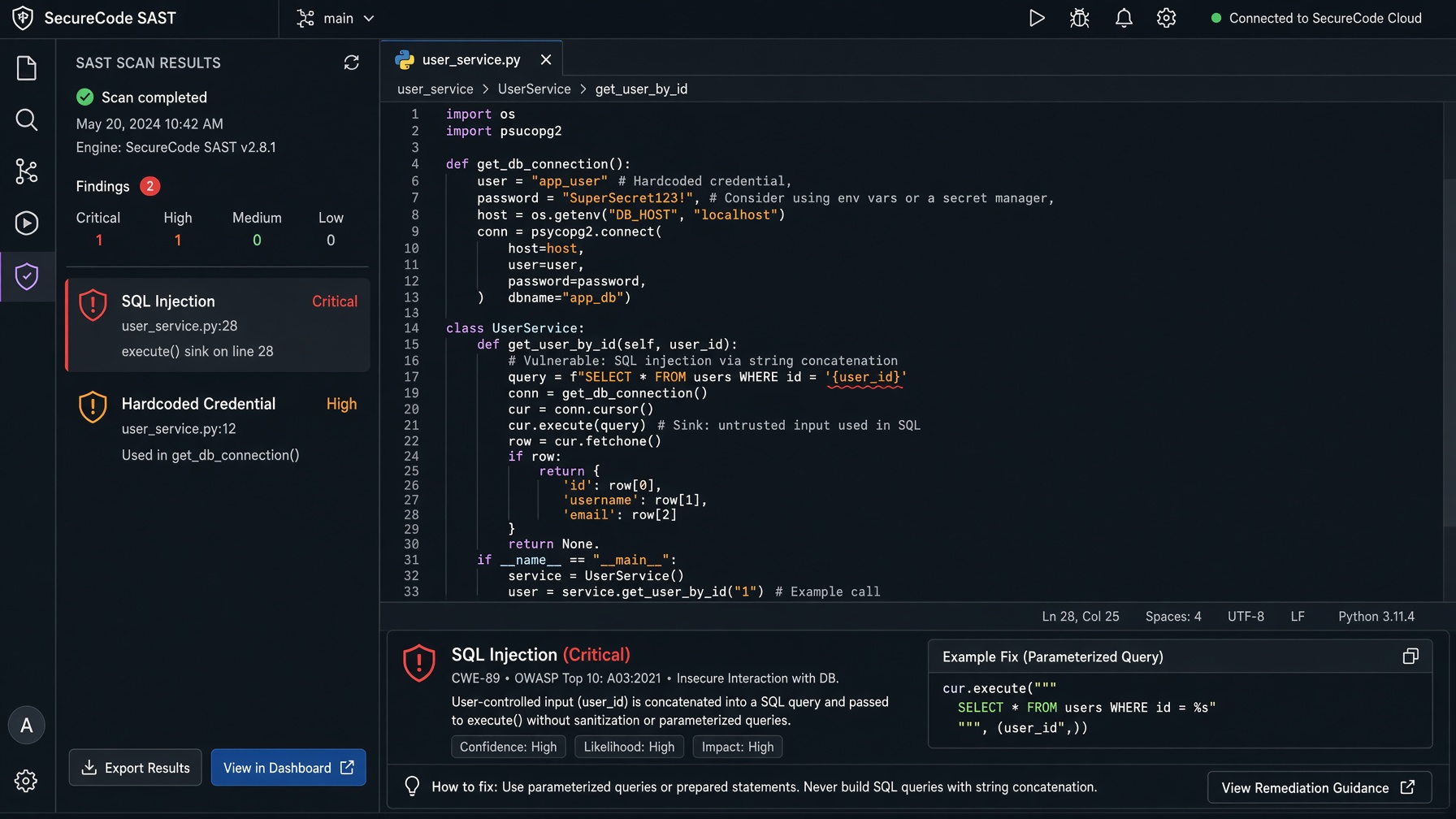
Security teams stop code-level flaws and runtime exploits from reaching production by embedding Static Application Security Testing (SAST) and Dynamic Application Security Testing (DAST) into the continuous integration/continuous delivery (CI/CD) pipeline. SAST examines source code, bytecode, or binaries without executing the application; DAST probes a running application from the outside and records its responses. Together they map directly to CompTIA Security+ SY0-701 objective 4.1 (application security techniques that include static code analysis) and objective 4.3 (vulnerability-management identification methods that list both static analysis and dynamic analysis).
How SAST Operates Inside the Pipeline
A developer commits code. The CI system immediately hands the source tree, intermediate language, or compiled binary to a SAST engine. The engine builds an abstract syntax tree and a control-flow graph, then walks every path looking for patterns that match known weakness classes: unsanitized string concatenation that enables SQL injection, buffer writes that exceed allocated bounds, hardcoded credentials, weak cryptographic primitives, and insecure deserialization. Because the analysis never runs the program, it reaches every branch—including those that live only in error-handling or feature-flag paths. Findings appear as line-level annotations that the developer sees before the build finishes. When the scanner reports a critical issue, the pipeline fails the build and blocks the merge. This early, white-box inspection aligns with the static code analysis control listed under SY0-701 4.1 and the static-analysis identification method under 4.3.
SAST tools also integrate with package-monitoring features. They flag third-party libraries that carry known Common Vulnerabilities and Exposures (CVE) identifiers, giving teams an immediate Software Composition Analysis signal without a separate scan. The same engine can enforce organization-specific secure-coding rules, turning policy into automated gates.
How DAST Operates Against a Live Target
After the build produces an artifact and the deployment stage spins up a staging instance, a DAST scanner takes over. It first crawls the application, discovering every reachable endpoint, form field, API route, and parameter. Next it generates attack payloads—malformed headers, encoded injection strings, session-token manipulations, and authentication-bypass attempts—and fires them at the running service. The scanner observes HTTP status codes, response bodies, redirect behavior, and timing anomalies. Any deviation that matches an exploit signature (for example, a reflected script fragment that signals cross-site scripting, or a database error message that reveals SQL injection) is recorded as a finding. Because DAST never sees the source, it surfaces only those weaknesses that an external attacker can actually trigger under the current configuration, authentication scheme, and runtime environment. This black-box approach matches the dynamic-analysis identification method required by SY0-701 4.3.
Modern DAST engines authenticate once, then maintain session state so they can exercise protected areas. They also respect rate limits and robots.txt-style exclusions to avoid overwhelming the test environment. Results feed back into the same ticket system used by SAST, closing the loop between code fix and runtime verification.
Complementary Coverage Across the Software Development Lifecycle
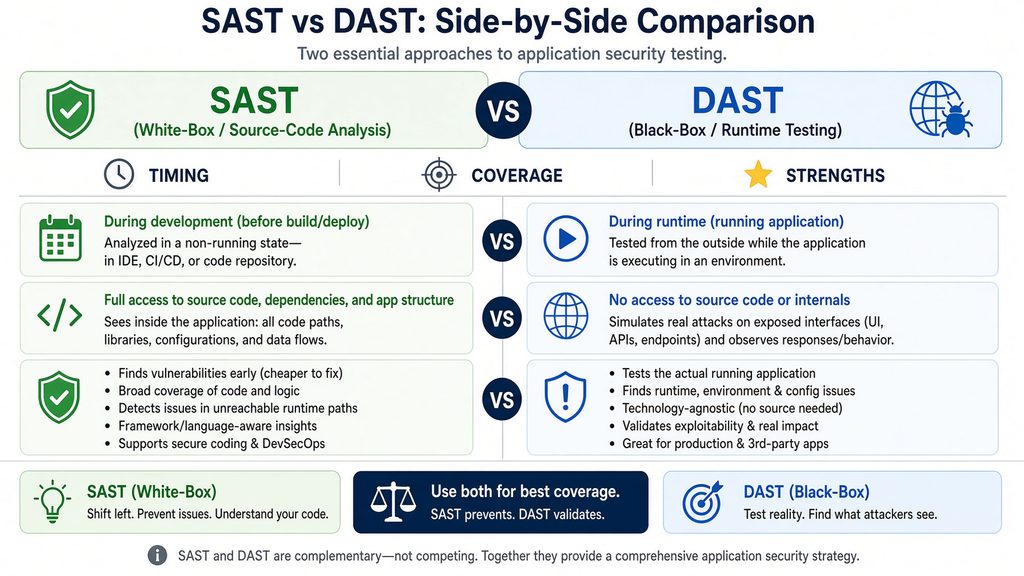
SAST and DAST occupy different points on the timeline and therefore catch different classes of defect. SAST runs at commit and build time; it finds latent coding errors before any binary exists. DAST runs after deployment into a realistic environment; it finds configuration mistakes, authentication logic flaws, and environment-specific issues that static analysis cannot see. A single vulnerability may appear in both scans—SAST flags the unsafe string concatenation, DAST later confirms the injection is reachable and exploitable—but many issues appear in only one. Teams therefore run both tools in sequence: SAST first to keep the cost of remediation low, DAST later to validate that the fix survives real traffic and configuration.
In a mature DevSecOps pipeline the two scanners share a common vulnerability database and severity scoring model. A finding that both tools report receives higher priority. False positives common to SAST (unreachable code paths) are filtered by the absence of a corresponding DAST hit. Conversely, a DAST finding without a matching SAST report often points to a misconfigured server or an insecure third-party component that never appeared in the source tree.
Mapping to Vulnerability-Management Activities
SY0-701 objective 4.3 requires candidates to explain identification methods that include application security via static analysis and dynamic analysis. Practitioners satisfy that requirement when they schedule SAST on every pull request and DAST on every staging deployment, then feed the combined results into the organizational vulnerability tracker. The same objective lists package monitoring; SAST engines that inventory dependencies fulfill that bullet. Once findings are recorded, the remaining vulnerability-management activities—analysis, remediation, validation, and reporting—proceed identically for both tool types. Validation often means re-running the original scanner after the fix lands, confirming the issue no longer triggers.
Practical Pipeline Integration Patterns
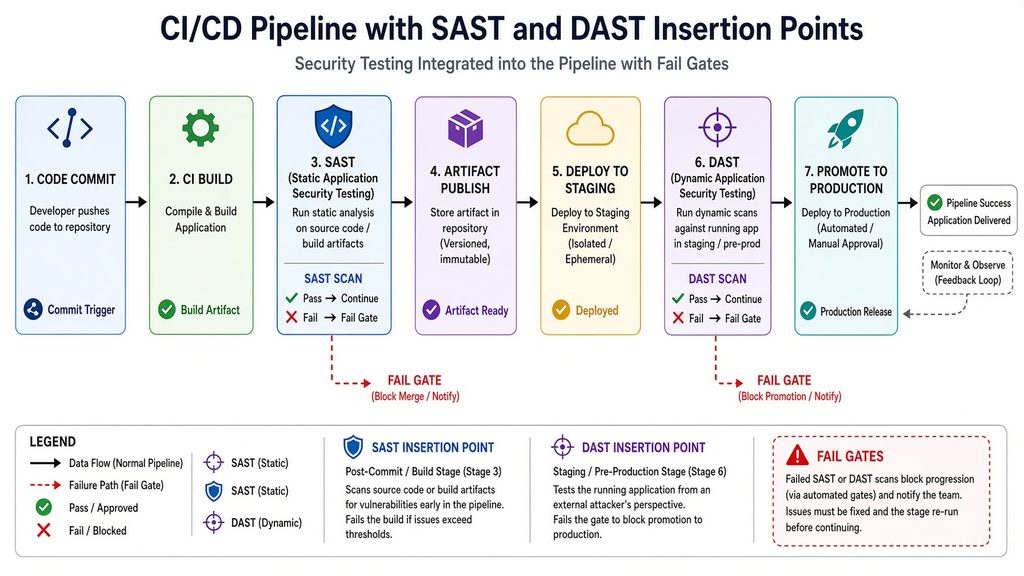
Teams insert SAST as a required stage immediately after the unit-test stage and before the artifact is published. They configure the tool to fail the pipeline on any high-severity or critical finding that matches the organization’s risk appetite. DAST runs as a scheduled or on-demand job against the staging namespace; its results appear as comments on the same pull request or as tickets that block production promotion. Both tools export machine-readable reports (SARIF, JSON, or XML) that SIEM and SOAR platforms ingest, satisfying the continuous-monitoring expectations of Domain 4.
When source code is unavailable—legacy binaries, third-party SaaS, or closed-source components—teams rely solely on DAST and package monitoring. When the application never exposes a network interface (batch processors, embedded firmware), SAST remains the primary control. In every other case the dual approach supplies the defense-in-depth coverage that SY0-701 expects from application-security and vulnerability-management practices.
Mastering the operational differences between SAST and DAST, and knowing exactly where each fits inside the pipeline, prepares candidates for the scenario-based questions that appear under objectives 4.1 and 4.3. For a complete map of every SY0-701 domain and the study path that ties these techniques together, see the full guide at https://legacyhaven.university/the-ultimate-guide-to-comptia-security-sy0-701-in-2026/.
Leave a Reply