
OAuth 2.0 solves the problem of granting limited, revocable access to protected API resources without sharing user credentials. The protocol defines four roles—resource owner, client, authorization server, and resource server—and moves authorization decisions through discrete token exchanges that enforce least privilege and continuous verification, aligning directly with CompTIA SecurityX (CAS-005) objectives for API security, access-control design, and Zero Trust subject-object relationships.
Under the hood, the resource owner authenticates once to the authorization server. The authorization server issues a short-lived access token that carries scoped claims. The client presents that token to the resource server on every API call. The resource server validates the token’s signature, audience, issuer, expiration, and any proof-of-possession binding before it returns data. Every subsequent request re-evaluates the same claims, supporting continuous authorization rather than a one-time gate.
Core Grant Types and Their Security Properties
OAuth 2.0 defines several grant types. Modern deployments, guided by RFC 9700, retain only those that prevent credential exposure and authorization-code injection.
Authorization Code Grant with PKCE
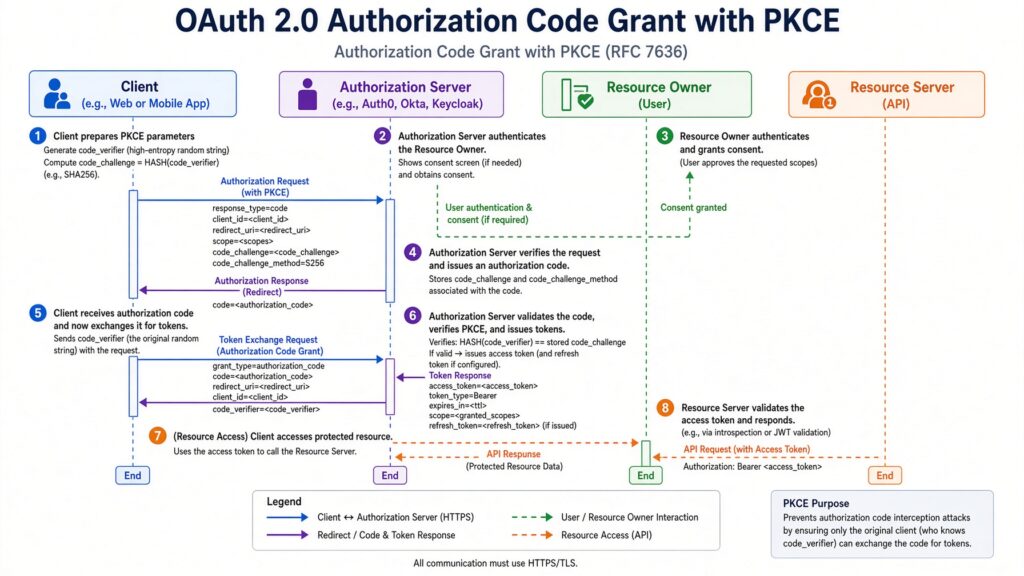
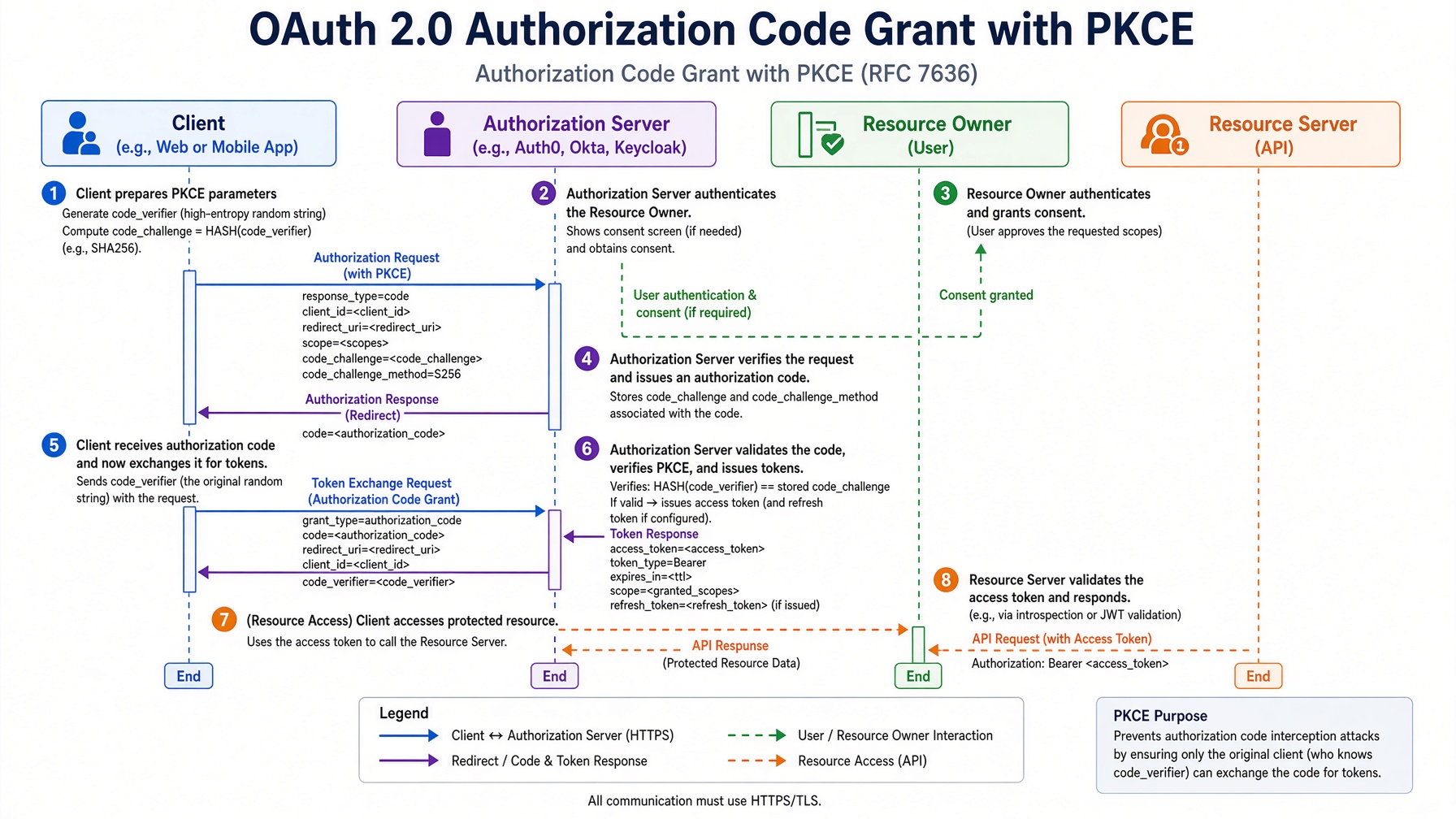
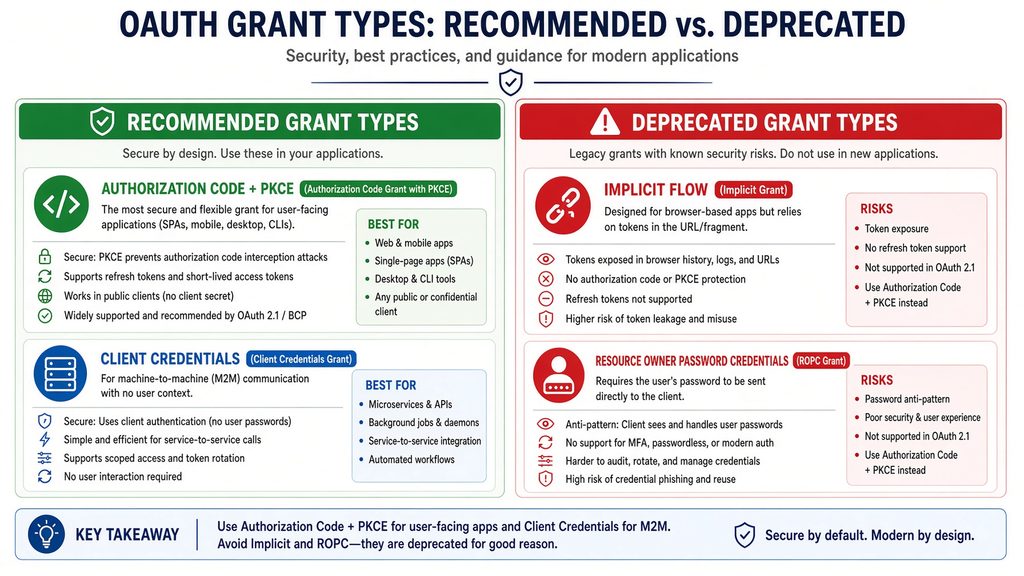
The client redirects the resource owner to the authorization server. The authorization server authenticates the owner and returns a one-time authorization code. The client exchanges that code, plus a dynamically generated code verifier, for an access token at the token endpoint. Proof Key for Code Exchange (PKCE) binds the code to the original client instance: the client first sends a hashed code challenge; later it proves possession of the matching verifier. This flow eliminates the need for a client secret on public clients (browser-based or native apps) and blocks interception attacks. CAS-005 expects candidates to select this grant for user-facing API clients.
Client Credentials Grant
A confidential client authenticates directly to the authorization server with its own credentials and receives an access token that represents the client itself, not a human user. No resource-owner interaction occurs. Security teams restrict this grant to machine-to-machine API calls and bind the token to a narrow audience and short lifetime.
Device Authorization Grant
Constrained devices without browsers obtain a short user code and verification URI. The resource owner completes authentication on a secondary device. The authorization server polls until the owner approves, then issues tokens. Deployments pair this grant with strict rate limits and short polling intervals to limit social-engineering windows.
Refresh Token Grant
When an access token expires, the client presents a refresh token to obtain a new access token without re-prompting the resource owner. Security controls rotate the refresh token on every use and bind it to the original client. Stolen refresh tokens therefore become detectable and unusable after a single exchange.
Legacy grants—Implicit and Resource Owner Password Credentials—are deprecated. The Implicit grant places the access token in the browser redirect fragment, exposing it to history, referrer headers, and logs. The password grant forces the client to handle the resource owner’s credentials, defeating the protocol’s core purpose.
Token Hardening Mechanics
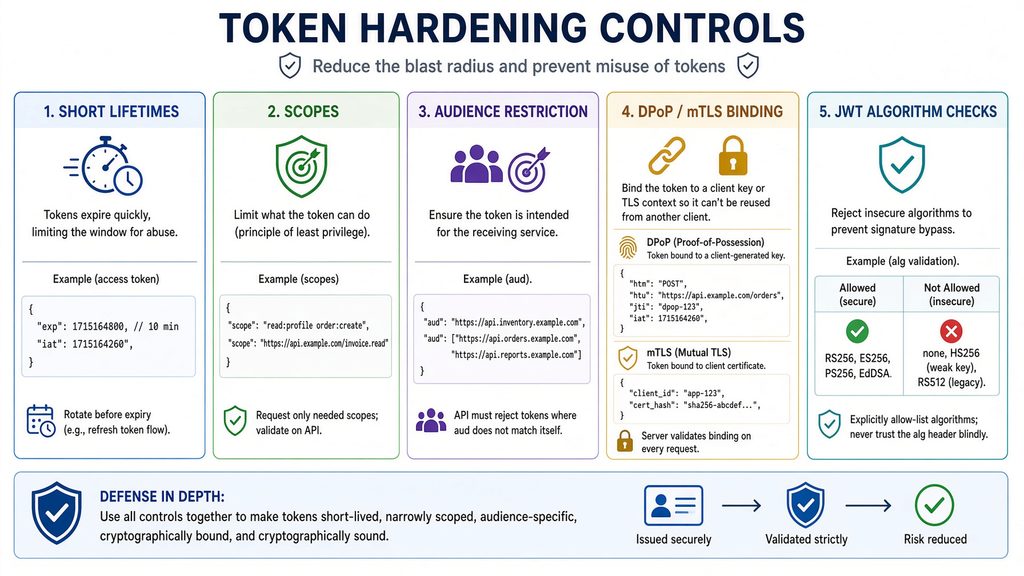
Access tokens travel as bearer tokens by default, so any party that obtains one can use it. Hardening converts them into sender-constrained, short-lived, narrowly scoped credentials.
Lifetime and Scope Reduction
Authorization servers issue access tokens with lifetimes measured in minutes (typically 5–15). Refresh tokens live longer but rotate on each use. Scopes limit the token to the exact API operations required; the resource server rejects any request outside those scopes. Audience claims (aud) further restrict the token to a single resource server, blocking substitution attacks in which an attacker replays a valid token against a different API.
Sender Constraint
Two primary mechanisms bind the token to the legitimate client:
- Mutual TLS (mTLS) certificate-bound tokens embed the client certificate’s thumbprint in a confirmation claim. The resource server verifies that the TLS handshake presents the matching certificate.
- Demonstrating Proof-of-Possession (DPoP) requires the client to sign a proof JWT with a private key for every request. The proof includes a hash of the access token; the resource server validates both the token and the proof.
Either technique renders a stolen bearer token useless outside the original client context.
JWT-Specific Controls
When tokens use JSON Web Token format, the authorization server signs them with an asymmetric algorithm (RS256, ES256, or EdDSA). Verifiers enforce an explicit algorithm allow-list and reject the “none” algorithm. Key identifiers (kid) map to a published JWK set retrieved over HTTPS. Libraries verify the signature, the iss claim, the aud claim, and the exp claim before any authorization decision. Sensitive data never appears in the JWT payload; the token carries only opaque identifiers and claims the resource server already knows.
Storage, Transmission, and Revocation
Clients store tokens in memory or in httpOnly, Secure, SameSite cookies. They never place tokens in local storage or URL parameters. All token endpoints and API calls enforce TLS 1.2 or higher. Authorization servers maintain a revocation endpoint and a token blacklist or introspection service so that compromised tokens can be invalidated immediately. Logging records every issuance, exchange, and validation event with subject, client, scope, and outcome for later audit and anomaly detection.
Rate Limiting and Continuous Authorization
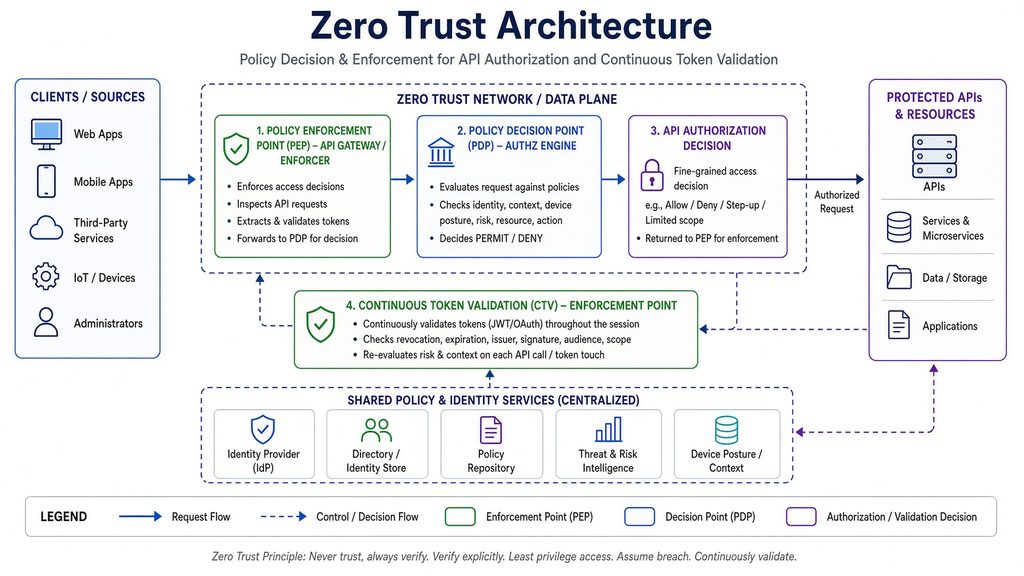
API gateways apply rate limits keyed to client identity and token. Exceeding the limit triggers throttling or temporary denial. Policy decision points evaluate additional context—device posture, location, time—on every request, implementing the continuous authorization required by Zero Trust architectures in CAS-005.
Integration with Enterprise Controls
In a CAS-005 scenario, architects place the authorization server behind a policy enforcement point that enforces mutual authentication and certificate pinning. Resource servers validate tokens locally when possible, falling back to introspection only for high-value operations. Secrets managers rotate client credentials and signing keys on a defined schedule. Federation with SAML or OpenID Connect supplies the initial identity assertion; OAuth then issues the API-scoped tokens. Logging feeds a SIEM that correlates token anomalies with other signals, closing the loop on detection and response.
These controls map directly to the SecurityX objectives covering API authorization, rate limiting, logging, Open Authorization, secrets management for tokens, and Zero Trust continuous authorization. Mastering the grant-type selection criteria and the concrete hardening steps—PKCE, short lifetimes, audience restriction, sender constraint, and algorithm pinning—prepares candidates to design and troubleshoot resilient API authorization systems. For the complete domain map and related architecture topics, see the Ultimate Guide to CompTIA SecurityX (CAS-005) at https://legacyhaven.university/ultimate-guide-to-comptia-securityx-cas-005/.
Authoritative References
- https://datatracker.ietf.org/doc/rfc9700/ (RFC 9700 – Best Current Practice for OAuth 2.0 Security)
- https://datatracker.ietf.org/doc/rfc7636/ (RFC 7636 – Proof Key for Code Exchange)
- https://datatracker.ietf.org/doc/rfc9449/ (RFC 9449 – Demonstrating Proof of Possession)
- https://www.comptia.org/en-us/certifications/securityx/ (CompTIA SecurityX exam overview and objectives summary)
Leave a Reply