
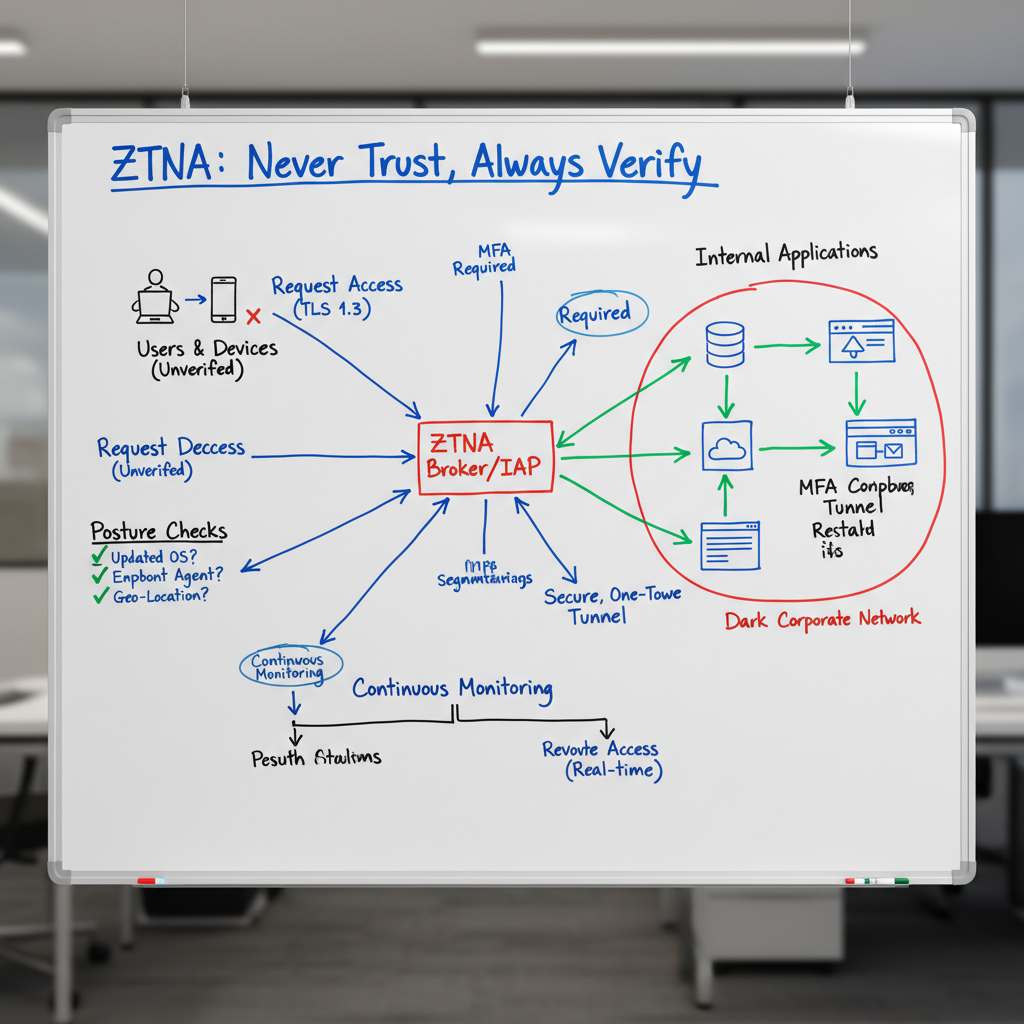
Zero Trust Network Access (ZTNA) replaces the inherently flawed perimeter-based security model of traditional VPNs by shifting access controls directly to the application level. It demands continuous verification of user identity and device health for every single digital interaction, completely eliminating implicit trust.
Virtual Private Networks (VPNs) create a wide-open tunnel into a corporate network. Once a user authenticates, the VPN grants them broad access to the internal network environment. This architecture creates a massive security risk. If an attacker steals a user’s credentials, they use the VPN to enter the network and move laterally (horizontally exploring network segments to find valuable servers and data) with zero resistance.
ZTNA destroys this outdated perimeter model. It operates on the core cybersecurity principle of “never trust, always verify.” Instead of connecting a user to a broad network, ZTNA connects a user strictly to one specific application. IT professionals mastering modern access control, such as those studying the Ultimate Guide to CompTIA Security+ SY0-701 in 2026, must understand how ZTNA dynamically enforces the principle of least privilege (giving users only the minimum access absolutely necessary to perform their jobs).
Under the hood, ZTNA relies on a broker gateway or an Identity-Aware Proxy (IAP). When a user requests access to an internal application, they do not connect to a traditional network firewall. Instead, the user initiates a request to the ZTNA broker. The broker intercepts the traffic and forces the user to prove their identity, typically through strong Multi-Factor Authentication (MFA).
Simultaneously, the broker evaluates the user’s device posture. Posture assessment means the system actively checks the requesting computer or phone to ensure it runs an updated operating system, operates an active endpoint detection agent, and originates from an approved geographic location. The ZTNA broker acts as the control plane (the system component that makes the security and routing decisions).
If the user and device pass these strict, real-time checks, the broker signals the data plane (the network path where the actual data travels). The system then establishes a secure, temporary, one-to-one encrypted tunnel (often utilizing the TLS 1.3 protocol) linking the user directly to the authorized application. The underlying corporate network infrastructure remains completely invisible, or “dark,” to both the user and the public internet. Furthermore, the broker continuously monitors this connection, revoking access instantly if the user’s risk context or device health changes during the session.
Authoritative References
https://www.comptia.org/certifications/security
Leave a Reply