
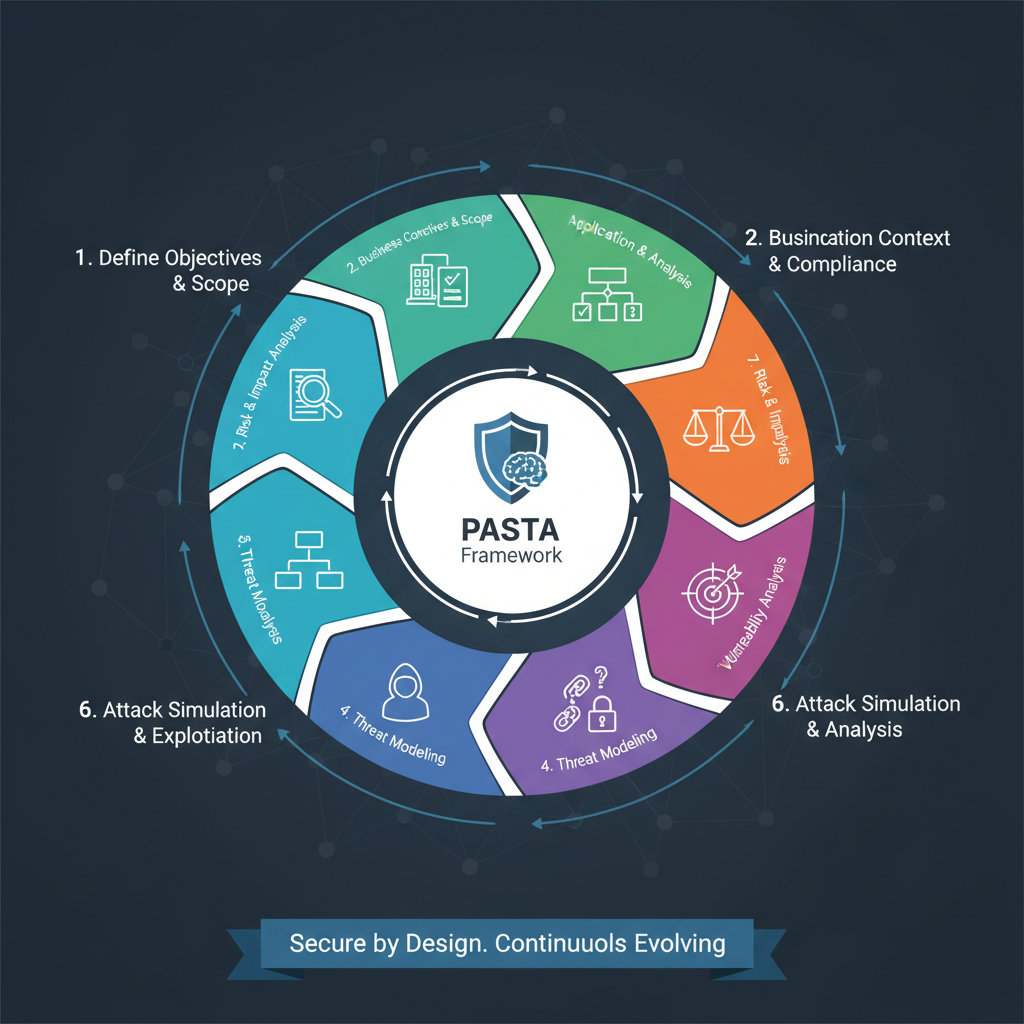
The Process for Attack Simulation and Threat Analysis (PASTA) framework integrates business objectives with technical requirements to quantify and mitigate cybersecurity risks. Unlike developer-focused models, PASTA forces security teams to view the network through the eyes of an attacker while prioritizing high-value business assets.
PASTA operates across seven distinct stages to align security controls directly with measurable business outcomes. In the first stage, analysts define business objectives. They identify exactly what the organization needs to protect, such as customer payment data or intellectual property, and establish the financial impact of a breach. Next, teams define the technical scope. They map the exact infrastructure, software dependencies, and cloud environments that support those specific business goals.
During the third stage, application decomposition, engineers break the system down into individual components. They create Data Flow Diagrams (DFDs)—visual maps that show exactly how information moves from users to databases. Engineers highlight trust boundaries on these maps. A trust boundary represents any point where data moves from a less secure environment to a more secure one, such as traffic passing from the public internet through a corporate firewall.
In the fourth and fifth stages, security teams conduct threat and vulnerability analysis. They analyze threat intelligence (actionable data about current attacker behaviors and campaigns) to identify who might attack the system. Simultaneously, they scan the decomposed application for existing vulnerabilities (flaws in the code, configurations, or design).
The sixth stage requires attack modeling. Security teams build attack trees—hierarchical diagrams that map the exact step-by-step paths a hacker must take to compromise a target. They simulate these attacks to prove whether the vulnerabilities actually expose the business to danger.
Finally, in the risk and impact analysis stage, leadership calculates the exact financial and operational damage a successful exploit will cause. They use this data to justify the cost of specific security countermeasures. To structure your study plan around risk-centric modeling and other enterprise security domains, review the Ultimate Guide to CompTIA SecurityX (CAS-005).
Leave a Reply