Category: Project+ (PK0-005)

The CompTIA Project+ (PK0-005) certification validates the essential skills required to manage and coordinate small-to-medium-sized IT projects, infrastructure rollouts, and software deployments. Modern technical project coordinators must bridge business requirements with operational technology, balancing scope, schedule, budget, and risk while ensuring cross-functional stakeholder alignment.

This resource hub provides actionable guides, Work Breakdown Structure (WBS) walkthroughs, change control templates, and performance-based question (PBQ) review scenarios mapped directly to the PK0-005 objectives. Explore predictive and adaptive project life cycle methodologies, resource planning tools, vendor management strategies, and regulatory compliance standards designed to help you pass the PK0-005 examination and execute successful IT initiatives.

  • Securing Endpoints: EDR/XDR Architecture & SELinux

    Endpoint Detection and Response (EDR), Extended Detection and Response (XDR), and Security-Enhanced Linux (SELinux) integrate to enforce deterministic access controls and dynamic behavioral analytics against advanced persistent threats. This defense-in-depth architecture prevents unauthorized kernel-level execution while continuous telemetry streams enable real-time threat hunting, automated isolation, and zero-day mitigation. EDR and XDR Architecture Mechanics EDR platforms…

  • Writing a Python Script to Automate Patching via SSH

    Automated patch management scripts utilize the Secure Shell (SSH) protocol to deploy security updates systematically across distributed server fleets, eliminating manual misconfigurations and accelerating vulnerability remediation. By leveraging Python libraries to handle cryptographic handshakes and command execution, security engineers enforce baseline compliance while maintaining secure, programmatic access to remote infrastructure. SSH Automation Mechanics and Architecture…

  • OT/ICS Security: Purdue Model Explained

    The Purdue Enterprise Reference Architecture (PERA) provides a structural framework for segmenting Operational Technology (OT) and Industrial Control Systems (ICS) from Enterprise IT environments. By enforcing strict hierarchical data flows, the Purdue Model minimizes the attack surface and prevents adversaries from pivoting from internet-facing corporate networks into critical physical infrastructure. Security professionals must master this…

  • Advanced Crypto: Homomorphic Encryption & Forward Secrecy

    Homomorphic encryption enables computational engines to execute arbitrary functions directly on ciphertext without exposing the underlying plaintext, securing data in use. Forward secrecy protects historical network communications by guaranteeing that a future compromise of a long-term cryptographic identity key exposes zero past ephemeral session keys. Homomorphic Encryption Mechanics Fully Homomorphic Encryption (FHE) constructs a mathematical…

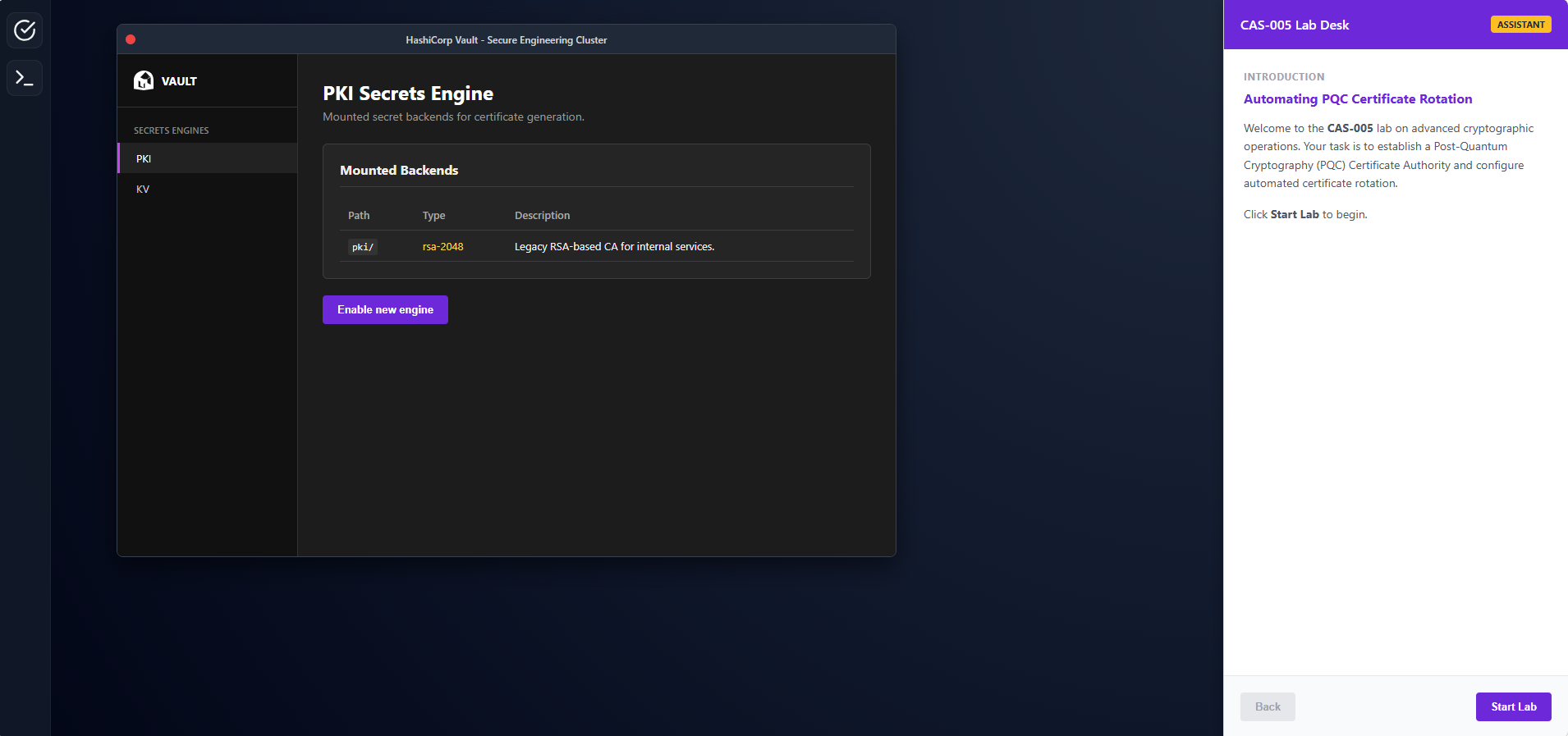
  • Post-Quantum Cryptography (PQC) for CompTIA SecurityX (CAS-005)

    Post-Quantum Cryptography (PQC) neutralizes the existential threat quantum computing poses to current asymmetric encryption algorithms by implementing mathematically resistant cryptographic primitives. Security architects deploy PQC to secure long-term data confidentiality and integrity against cryptanalytically advanced adversaries executing “harvest now, decrypt later” attack vectors. Quantum Threat Mechanics and Cryptographic Vulnerability Quantum computers utilize qubits and superposition…

  • Integrating Controls: Attack Surface Management & Hardening

    Veteran practitioners master attack surface management by relentlessly shrinking the opportunities adversaries exploit. They treat every exposed asset, protocol, and configuration as a potential entry point and systematically eliminate or fortify those vectors. In CAS-005 terms, this discipline drives secure architecture design, where teams integrate vulnerability management, hardening, and defense-in-depth to deliver resilient systems. Determining…

  • Lab: Securing Docker Images with Trivy Automation

    Vulnerabilities in container images expose organizations to supply chain attacks and runtime exploits. Trivy detects these issues early by scanning for known vulnerabilities, misconfigurations, secrets, and licenses in Docker images and their dependencies. Security teams integrate Trivy into CI/CD pipelines to enforce secure builds and block vulnerable images from reaching production. Prerequisites Install Docker on…

  • Lab: Using Nmap Analysis to Identify Devices and Roles, and Hardening Violations

    Interpret Nmap scan results under strict hardening guidelines by mapping each IP to exactly one primary service on its default port while flagging non-compliant ports and insecure protocols. This lab strengthens your ability to enforce services per device, default-port discipline, and secure-protocol mandates. For comprehensive coverage of advanced security operations and network hardening techniques, visit…

  • Step-by-Step: Configuring a WireGuard VPN Tunnel

    WireGuard delivers modern, lightweight VPN tunnels that secure remote access and support deperimeterization strategies. Practitioners deploy it to enforce zero-trust principles, reduce attack surfaces, and integrate seamlessly into SASE architectures. This tutorial walks you through a production-grade setup on Linux servers and clients. Follow these steps precisely to establish encrypted, high-performance tunnels. Generate Cryptographic Keys…